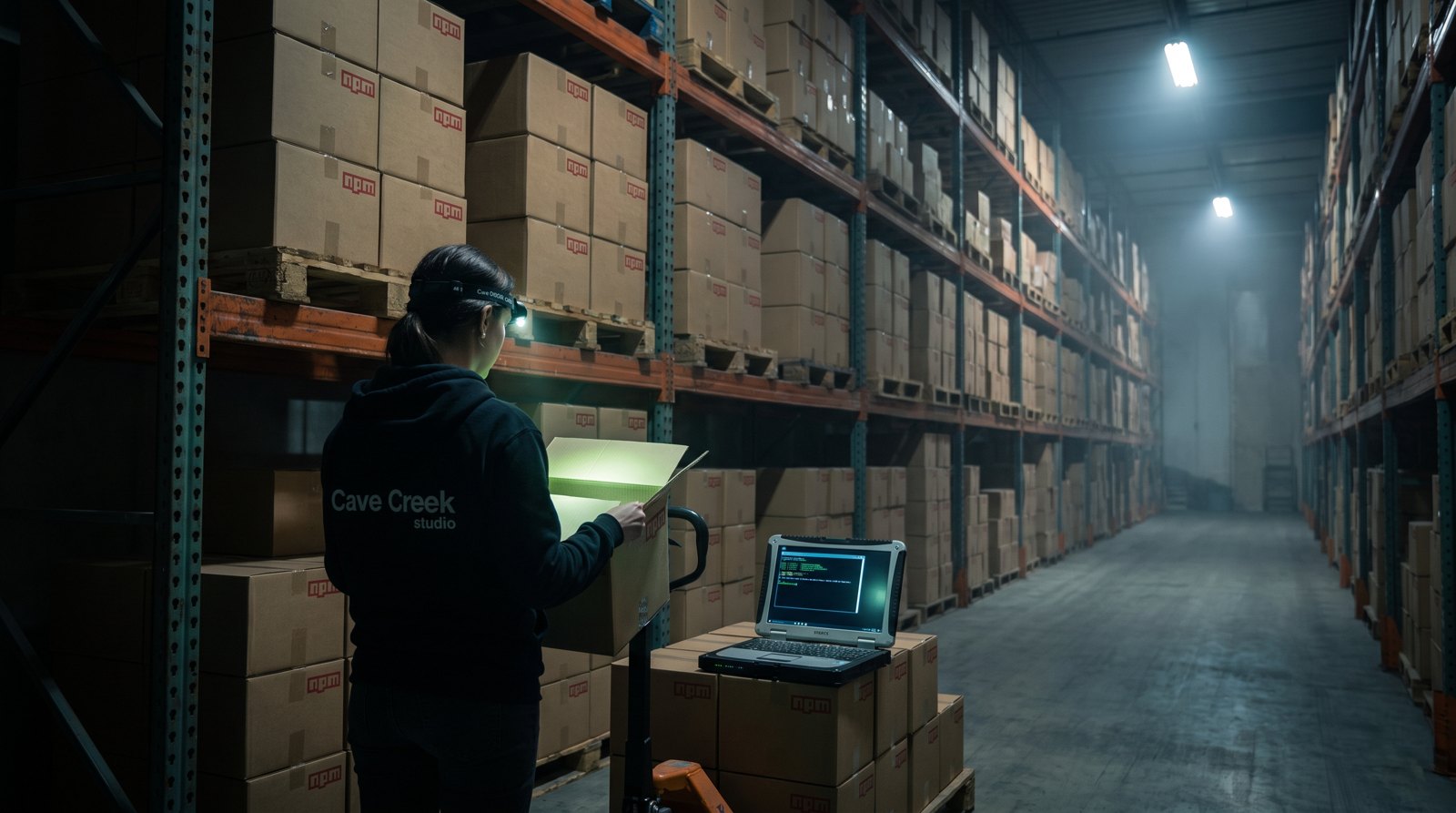
Security researchers at Sonatype have flagged a campaign they call "Flooding Dropper": roughly 850 malicious software components pushed into npm, a huge public library of free code that developers pull from when building things. Rather than one busy account publishing lots of bad packages, the attackers spread a few across many throwaway accounts, which makes them much harder to clean up.
Here is why this matters to you even though you will never touch npm yourself. Almost every modern website is assembled partly from these free components. Your contact form, your image slider, your booking widget, your build tools. Nobody writes all of that from scratch. So the question is not whether your site depends on other people's code, it is whether anyone checks what got pulled in and when.
The practical risk is narrower than the headline suggests. These packages generally have to be installed by a developer during a build, so a site that has been sitting untouched for two years is not suddenly at risk from this campaign. The exposure comes at the moments when work is happening: a new feature, a plugin update, a fresh developer setting up your project. That is when a mistyped or lookalike package name can slip in.
Sonatype also noted npm accounted for 96.6% of malicious package counts in their Q2 2026 index. That is not a reason to panic about your website. It reflects how enormous and open that particular library is compared to others.
What you should actually do:
- Nothing today, if your site is stable and nobody is actively building on it.
- Next time you speak to whoever maintains your site, ask two questions: do we keep a record of the outside code our site depends on, and does anything automatically check those dependencies for known problems? Both are ordinary practice, not exotic requests.
- If a developer is doing work for you right now, it is fair to ask how they verify a package before adding it. "I checked it was the real one, from the real publisher" is the answer you want.
This is a supply chain story more than a website story. Worth knowing about, not worth losing sleep over.
Reported by: